
How companies align their organization, systems, and customer experience so that every customer interaction becomes a competitive advantage.
A customer-centric organization puts the customer at the center of not only its strategy but also its operations. It uses real-time data to manage interactions across all channels in a targeted manner. Technology itself is not enough. What is crucial is a profound change in culture, structures, and processes.
Real-time customer centricity can only succeed if all levels of a company are consistently focused on the moment of decision. This means breaking down silos, shortening decision-making paths, making data streams usable, and shifting responsibility to where customer contact takes place.
This is exactly where our Real Time Customer Centricity (RTCC) operating model comes in. It combines adaptive customer experience, agile organizational principles, and a scalable system and data architecture into an integrated framework.
The result: automated processes, decentralized decision-making, and measurable impact – an operating system for sustainable, customer-centric growth.
The DevelopX Operating Model for Real-Time Customer Centricity
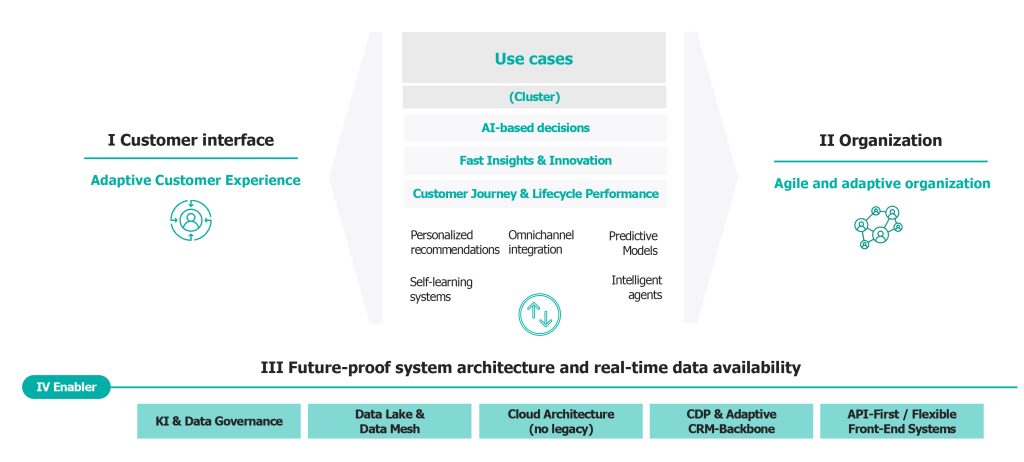
The RTCC Operating Model describes the central building blocks that companies use to systematically embed real-time customer centricity. Operationally, technologically, and organizationally. It is divided into four dimensions:
I. an intelligently controlled customer interface,
II. an agile and adaptive organization,
III. a future-proof system architecture, and
IV. concrete technological enablers at the data and process level.
The result is a framework that enables companies to not only promise customer proximity, but also to implement it consistently, promptly, and with measurable business impact.
I. Customer interface – Adaptive customer experience
Efficient customer experience management (CXM) is now much more than just a nice-to-have. It is a key lever for customer loyalty, brand loyalty, and sustainable growth. To not only meet but exceed customer expectations, you need a consistently well-thought-out combination of value-oriented processes, holistic journey management, and modern service design.
Every touchpoint is optimized based on actual customer value, silos are broken down to manage expectations across channels and in real time, and experiences are designed to be intuitive, user-friendly, and emotionally compelling. The result: consistent, personalized experiences that feel like a real competitive advantage rather than just marketing.
Value Stream Focus
Value-oriented processes in CXM aim to align all processes and activities in such a way that maximum value is created for the customer. By identifying and analyzing value streams, companies can eliminate inefficient processes and ensure that every action contributes to improving the customer experience. This approach not only promotes efficiency, but also customer satisfaction, as it is consistently geared toward the needs and expectations of customers.
Holistic, adaptive journey management
Holistic journey management considers the entire customer journey across various touchpoints. By mapping these customer journeys, companies can understand and optimize customer expectations and experiences at every stage. Optimization is automated and real-time wherever possible, or through close, cross-functional collaboration in agile teams and the use of data to create personalized and relevant interactions.
This approach makes it possible to overcome silos within the company and deliver a consistent, seamless customer experience.
State-of-the-art service design
Modern service design integrates methods and tools that aim to design services from the customer’s perspective. By applying service design principles, companies can develop services that are not only functional, but also enjoyable and intuitive. Aspects such as user-friendliness, accessibility, and emotional connection are taken into account. Effective service design leads to an improved customer experience, increases customer loyalty, and strengthens brand perception.
By integrating these elements into customer experience management, companies can ensure that they not only meet their customers’ expectations but exceed them, ultimately leading to long-term success and competitiveness.
II. Agile and adaptive organization
Successfully establishing real-time customer centricity requires an organization that is flexible, data-driven, and customer-centric. This calls for fast decision-making processes, adaptable structures, and a culture of continuous learning.
Three key principles form the basis for this:
Lean governance & learning culture
Lean, decentralized management and a strong learning culture make companies more agile and responsive. Instead of rigid hierarchies, data-driven decision-making processes are needed to anticipate market and customer changes in real time.
Companies with a strong learning culture embrace a test-and-learn mentality: new ideas are tested quickly, real-time data replaces past-oriented decisions, and continuous optimization becomes the norm. AI-powered analytics help identify customer needs in a fraction of a second and respond immediately—from personalized offers to process automation.
This combination of lean governance and a learning culture not only makes companies more efficient, but also more innovative. It lays the foundation for a dynamic, customer-centric organization that is constantly evolving.
Agile and cross-functional teams
Autonomous, customer-centric, and cross-functional teams are the key to an agile organization. Instead of long decision-making processes, they work across departments, have clear responsibilities, and implement initiatives independently.
Close, cross-functional collaboration between different roles within the team allows customer feedback and market data to be directly translated into new solutions. This not only allows products and services to be optimized more quickly, but also enables processes to be continuously adapted.
Companies that rely on cross-functional teams benefit from greater adaptability, shorter innovation cycles, and a better customer experience. They create an organizational structure that adapts flexibly to change and acts consistently in a customer-oriented manner.
Decision-making autonomy
Fast, data-driven decisions are the key to competitive advantage today. Traditional hierarchical structures slow companies down because lengthy coordination processes prevent them from responding flexibly to customer and market changes. Those who still rely on centralized control will lose out to agile competitors who make decisions where they are needed: in the teams that interact directly with customers.
Decentralized decision-making structures and AI-supported real-time analyses enable companies to respond immediately to customer needs instead of waiting for reports. Measures are implemented where the knowledge lies: at the customer interface. This not only increases the speed of decisions, but also their accuracy.
Because today, it’s no longer the biggest who wins, but the fastest. Market leaders are not those who have the most resources, but those who recognize trends early and act immediately. Those who learn from data in real time can anticipate customer expectations and exploit competitive advantages before others even react.
“Agility beats hierarchy. Real time beats the past. And speed beats size.”
III. Enabler: Future-proof system architecture and real-time data availability
The success of real-time customer centricity depends largely on a powerful system architecture and the intelligent use of data. Companies need scalable and networked IT systems that enable real-time analysis and ensure the seamless integration of AI technologies.
Future-proof system architecture
A modern and future-proof IT architecture and the replacement of legacy systems form the basis for data- and AI-driven decisions. Companies must ensure that their systems are powerful, flexible, and interoperable.
This includes:
Real-time data availability
Systems must be able to process large amounts of data within milliseconds and make it available for analysis immediately.
Data quality
In addition to availability, high data quality is essential. Only reliable data enables accurate decisions.
Scalable cloud and edge computing solutions
Decentralized data processing accelerates processes and significantly reduces latency.
APIs and microservices
Modular IT architectures enable rapid responses to new business requirements and ensure the smooth integration of AI technologies.
Security and compliance
Data must not only be accessible, but also secure and processed in compliance with GDPR.
Data-driven automation & personalization
AI-powered decision-making reduces manual processes while optimizing the customer experience. By analyzing large amounts of data in real time, AI makes automated, informed decisions and enables faster and more accurate customer interactions.
Personalized recommendations
Offers are dynamically tailored to customer behavior and individual preferences in real time to ensure maximum relevance at the right time.
Predictive problem detection
Artificial intelligence detects potential problems early on and automatically initiates preventive measures before the customer even has to react.
Intelligent assistance systems
Chatbots and virtual assistants automatically respond to inquiries, increasing service speed while reducing the workload on internal teams.
The result: efficient, personalized service that not only increases customer satisfaction, but also optimizes resources and improves scalability.
Artificial intelligence as an accelerator
AI is revolutionizing customer interaction by enabling a new level of personalization. By analyzing real-time data, it recognizes individual behavior patterns and can anticipate needs even before the customer expresses them. The decisive factor here is not the technology itself, but how it is used.
Three levers make the difference:
AI-powered instances and agents independently take on routine tasks and interact directly with customers. They are precise, scalable, and available around the clock.
Self-learning systems continuously adapt to new data and dynamically optimize every customer interaction for greater impact with every contact.
Omnichannel integration ensures that AI does not act in isolation, but across all channels – from the web to apps to voice and IoT – to deliver a seamless, consistent experience.
IV. Enablers on the system and data side
To ensure that real-time customer centricity does not remain a mere strategy, a technological foundation is needed that not only collects data but also makes it intelligent, scalable, and secure. The following building blocks form the backbone of a data architecture that makes AI effective and enables genuine customer proximity in real time.
AI & Data Governance, Strategy & Architecture
A solid data strategy and architecture are crucial for the successful deployment of AI. Data governance ensures that data quality, data security, and data usage comply with company guidelines and legal requirements. Clear guidelines and responsibilities enable companies to manage their data efficiently and make it usable for AI applications. An important prerequisite for real-time customer centricity is the availability of data and the ability to link data from different sources in real time.
Data Lake & Data Mesh
Data mesh is a decentralized approach to data architecture in which responsibility for data is distributed across different domains. Each domain treats its data as a product and is responsible for its quality and delivery. This approach promotes the scalability and flexibility of the data infrastructure and enables teams to develop and use data products independently of each other.
Cloud architecture and replacement of legacy systems
The transition to cloud-based architectures enables companies to respond flexibly and scalably to modern requirements. By replacing outdated legacy systems, companies can benefit from the advantages of the cloud, such as improved data access, cost efficiency, and faster implementation of new technologies.
Customer Data Platform & Adaptive CRM Backbone
A customer data platform (CDP) integrates customer data from various sources to create a unified customer profile. Combined with an adaptive CRM backbone, companies can deliver personalized interactions and offers in real time, increasing customer loyalty and satisfaction.
API-first approach and flexible front-end systems
An API-first approach ensures that all services and applications can communicate via standardized interfaces. This enables the development of flexible front-end systems that can be easily adapted to new requirements. This modularity allows companies to respond more quickly to market changes and implement innovative solutions.
Data becomes growth with the right operating model
If you think about real-time customer centricity, you can’t stop at technology. What matters is the interplay between organization, processes, and system architecture, orchestrated in an operating model that not only scales but also delivers real impact. The DevelopX RTCC operating model does just that: it combines adaptive customer experience, agile teams, and data-driven decisions into an operating system for dynamic growth.
What does that mean for your business? Shorter decision cycles, higher conversion rates, lower process costs and customer relationships that feel like competitive advantages.
Start seeing results now instead of waiting for the next report
Interested in an RTCC setup that works in practice, not just on paper? Then let’s talk. In a compact executive briefing, we’ll show you how real-time customer centricity can work in your organization – in concrete, actionable, measurable terms.
📩 Secure your non-binding appointment with our partner Daniel Olesen-Fett to learn more about the RTCC Operating Model.