
A Strategic Guide to Nearshore Software Development Hubs in Portugal
Building digital capabilities is no longer a choice between in-house and outsourcing; it’s about combining speed with ownership. The Build-Operate-Transfer (BOT) model strikes that balance. It gives companies quick access to top-tier tech teams and a clear path to internalization with no initial risk. As CTOs and CPOs shift their focus from outsourcing to developing long-term capabilities, the BOT model is emerging as the preferred approach.
This article demonstrates how to leverage nearshore BOT setups, particularly in high-potential hubs such as Portugal, to accelerate delivery, mitigate risk, and generate enduring value through lean governance and comprehensive execution.
Choosing the Right BOT Model
The BOT model is implemented in two main archetypes, each of which is tailored to different strategic needs:
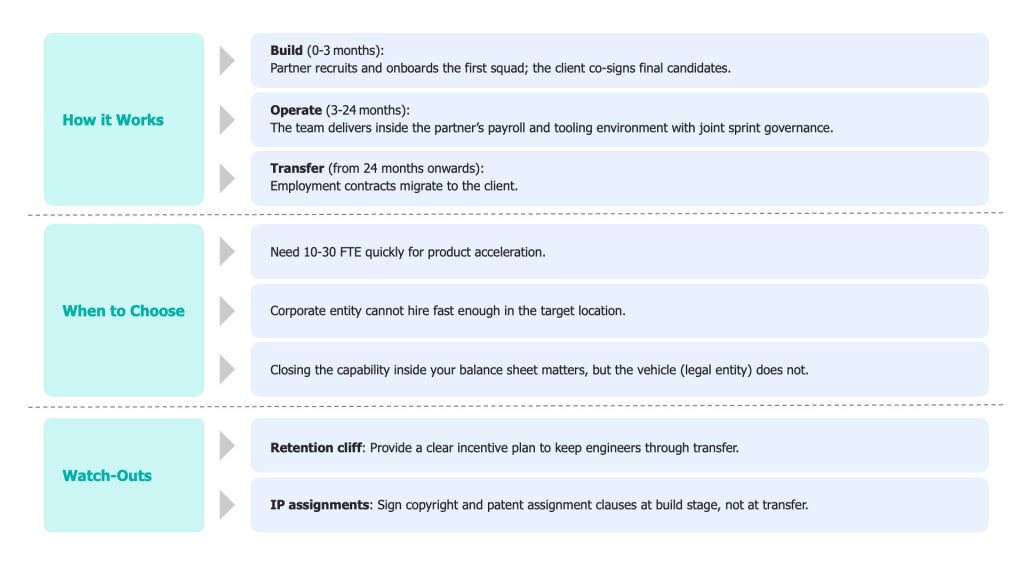
The lightweight BOT model prioritizes speed and simplicity. A dedicated, pre-vetted team is assembled and managed by a partner with the intention of transferring the employment contracts to the client after a set period of time, typically 24 months or more. This model provides a quick route to in-house capabilities without the need to establish a legal entity beforehand.
In contrast, the heavyweight BOT model is a long-term investment strategy. Here, the partner incubates a legal entity from scratch and scales it over two to four years. Once the entity is fully operational, the client acquires 100% of the share capital, gaining ownership not just of the team, but also of the entity, its infrastructure, and its operations.

Lightweight BOT (Contractual engineer transfer)
Lightweight BOT works when speed and flexibility outrank long-term brand permanence and when the intended overall team size does not justify additional complexity and overhead involved with handling a new legal entity. It enables companies to rapidly expand their delivery teams, operate with minimal overhead, and maintain a clear path to future ownership without committing to a complete legal infrastructure from the outset.
Heavyweight BOT (Entity build‑up and share acquisition)
Heavyweight BOTs often establish large nearshore hubs with 30 to 300 engineers before changing ownership. This model is repeatable, though the legal aspects are dense. This model is ideal if you need a long-term strategic presence, full operational control, and employer branding in the target market for your growth plan.
Three‑phase timeline
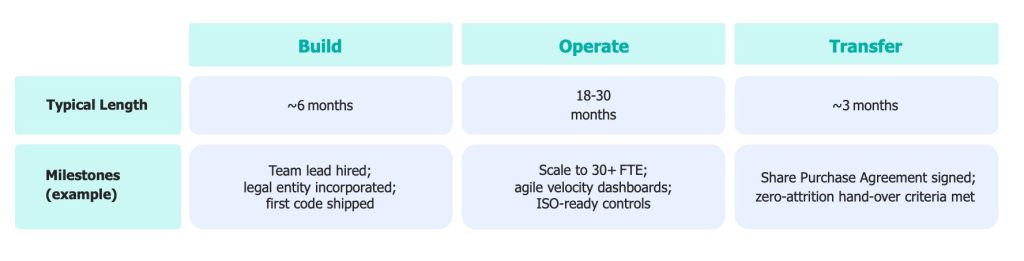
Heavyweight BOTs follow a structured, three-phase timeline from setup to full transfer. Each phase has clear milestones that ensure scalability, compliance, and long-term value.
Complexities you must master
In order to successfully execute a heavyweight BOT, companies must navigate a variety of legal, financial, and operational issues. Mastering these topics early on is key to ensuring a smooth ramp-up and a clean, risk-free transfer.
Legal setup
Incorporate NewCo with partner as initial shareholder; optionally grant the client a 1 % golden share to ease funding flows.
Capitalisation & liquidity
Bridge operating cash via intercompany loan; maintain open‑book reporting so the client has transparency on runway and burn.
Tax & compliance
Keep NewCo margin thin to avoid permanent‑establishment risk; align service‑fee model upfront.
Governance during ramp‑up
Monthly Steering Committees focus on hiring funnel, time‑to‑hire, and budget, while weekly ops syncs remove blockers.
Cultural integration
Cross‑site off‑sites and buddy programmes drive belonging; retention rates above 90 % are achievable.
IP security & ISMS
Establish an ISO 27001‑aligned ISMS for NewCo early; formal certification can follow post‑transfer.
Pro tip: Start forming your entity at least six months before your planned cut-over date. This allows enough time for registration, banking, payroll, and DPA sign-offs.
BOT vs. Other Sourcing Models
BOT is not a one-size-fits-all solution. It falls somewhere between traditional outsourcing and full in-house development. To make the right sourcing decision, companies must consider speed, control, and ownership. The table below outlines where each model delivers the most strategic value and where BOT may not be the best fit by comparing BOT models with other common sourcing approaches.

Where BOT is not the best fit
While BOT offers strong benefits, it’s not always the right tool. In some cases, simpler or more flexible models are a better choice.
- Uncertain product road‑map:
If the backlog may vanish within a year, staff augmentation is safer. - Highly regulated on‑prem workloads:
Data‑residency constraints can stall nearshore entities. - Very small scale (<10 FTE):
Governance overhead outweighs benefits; use managed teams instead.
Designing Your BOT Decision Framework
The first step in selecting the appropriate BOT setup is establishing a clear decision framework. Key factors include strategic intent, such as establishing a long-term technological presence or accelerating delivery; expected team size; project duration; and risk tolerance. Cultural integration, leadership hiring, and exit flexibility also play critical roles. The following guide outlines important dimensions for designing a BOT model that aligns with your growth plan.
Strategic intent – Will you own a regional tech brand or just unblock delivery?
Volume & longevity – Pipeline of at least 30 FTE over three years justifies heavy BOT capex.
Risk appetite – Can you navigate foreign tax, labor law, and SPA negotiations?
Talent mix – Seed hybrids first (team leads) to accelerate culture.
Exit clauses – Bake in downsizing and earn‑out mechanisms early for optionality.
Lessons from the Field
The successful execution of a BOT depends on three critical factors: speed, stability, and security.
Typically, the first engineer is onboarded within 8 to 12 weeks, and a functional core team of 30 or more full-time equivalents can be in place in under a year. This enables early product traction without long ramp-up phases.
Retention economics is equally important. With structured onboarding and defined career paths, attrition rates remain below 10%, which is 50% lower than the European average. The result is continuity, commitment, and a smoother transfer phase down the line.
One of the most underestimated risk factors is security setup. Delayed System and Organization Controls (SOC) routines or weak governance can delay the Share Purchase Agreement by months. Controls and compliance must be established early, ideally during the Operate phase, to ensure audit readiness and stakeholder confidence.

Speed, Scale & Compliance: Why Portugal Leads for Nearshore BOT
When it comes to developing long-term nearshore capabilities, Portugal stands out, offering a rare combination of technological expertise, affordability, and regulatory alignment.
Its talent pool is a key differentiator. When adjusted for population, Portugal has one of the highest densities of engineers in Europe. Salaries are up to 50% lower than in Western European tech hubs, enabling faster, more cost-effective team expansion without compromising quality.
Cultural proximity and English fluency ensure seamless integration. Portuguese engineers are comfortable working in English and operate with full CET overlap, enabling real-time collaboration with European product and engineering teams.
From an operational standpoint, Portuguese hubs can offer full GDPR compliance from day one, and ISO 27001 certifications are common. These certifications provide the security and governance standards necessary for enterprise-grade delivery.
Finally, government incentives, including R&D tax credits and streamlined visa programs, can further reduce the total cost of ownership and accelerate access to talent.
For companies seeking a nearshore location that enables fast scaling, seamless collaboration, and built-in compliance, Portugal delivers on every front.
Why Portugal leads for Nearshore BOT:

Flexibility First
Modern BOT offers more than just the choice between building everything in-house or outsourcing indefinitely. When executed properly, BOT allows for a quick increase in team size during critical phases, establishes a clear path to internal ownership, and creates a transferable asset, whether it’s a squad of 20 people or a hub of 200 people in Lisbon.
DevelopX supports both BOT archetypes with a proven methodology, ranging from contract-based team transfers to full legal entity build-outs. Our approach aligns with EU law, ISO 27001, and client-specific KPIs. We start lean, operate transparently, and transfer cleanly.
Now is the time to rethink BOT:
- When speed matters, but long-term control does too.
- When internal hiring can’t keep pace with delivery needs
- When nearshoring should be a strategic advantage, not a compromise.
Let’s discuss your nearshore roadmap and how BOT can support it.
Reach out at any time to discuss the best nearshore setup for your organization.